FLAC vs MP3 blind test: where the audible difference ends
A blind test of FLAC vs MP3 exists for one reason: in a normal argument the files already tell you which is which. You are not hearing sound, you are hearing the label in your player. Hide the filename, match the loudness, and the whole debate shrinks to one plain question: can you tell which of the two versions is playing right now?
Why the usual FLAC vs MP3 argument proves nothing
Open any thread. One half is certain that lossless gives itself away instantly. The other half is certain that MP3 at 320 kbps is transparent. Both listened to their own music while looking at the filename and the bitrate.
Expectation is faster than hearing. When the screen says FLAC, your brain fills in air around the cymbals and depth under the bass. When it says MP3, the same hiss turns into a codec artifact. That is not stupidity, it is how perception works in everyone.
The second hidden factor is loudness. Whichever version plays slightly louder almost always sounds better. One decibel is enough to move a verdict, even though the codec has nothing to do with it. So an honest comparison starts by matching level: ABXtest brings A and B to the same loudness using EBU R128, so you compare compression and not volume.
What ABX is and how it removes the hints
Blind here is not a mood. It is a protocol called ABX, boring enough to be worth trusting.
You listen to A, one version of a short passage. Then B, the other version of the same passage. Then X, which is secretly either A or B. Your job is one thing: say what X was. No ratings out of ten, no talk of soundstage and air. Just one choice out of two.
Then the ladder starts. Two correct calls in a row at one bitrate and the MP3 gets harder: the bitrate goes up, the artifacts hide deeper. Two mistakes and the run ends. What is left is one number: the highest MP3 bitrate where you still told it apart from lossless.
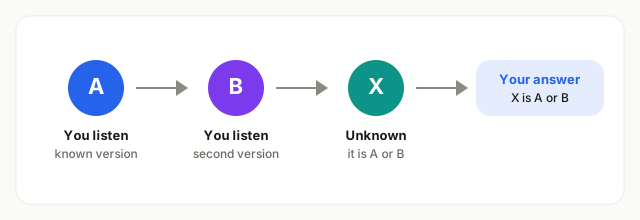
The lossless side here is WAV from the same master the MP3 was made from. FLAC and WAV sound identical: both carry the original samples, FLAC just packs them to save space. So the test answers exactly the question people ask when they type FLAC vs MP3.
Bitrate matters more than the format logo
The phrase FLAC vs MP3 is too wide on its own. MP3 at 96 kbps and MP3 at 320 kbps are different animals, and the gap between them is bigger than the one between 320 kbps and the original. That is why the test climbs in steps:
- 96 kbps the level of old radio streams. Usually audible even on cheap headphones: cymbals hiss, the top end smears.
- 128 kbps the classic free streaming tier. Tidier already, though on dense music the trick often still shows.
- 256 kbps roughly what many paid music and video subscriptions hand you.
- 320 kbps the ceiling for MP3. This is where honest hearing usually stops separating compression from the source consistently.
None of this is a medal for your ears or a verdict on your gear. It is a map of where the audible difference ends for you.
How to take the blind FLAC vs MP3 test on your own headphones
Somebody else's photo of a DAC does not answer whether you hear a difference. Your setup and your ears do.
- Sit in a quiet room with the headphones or speakers you actually use every day.
- Turn off everything that improves the sound: equalizer, bass boost, Spatial Audio, the branded modes in your headphone app. Those effects smear exactly the small details that separate the two versions.
- Set a calm, comfortable volume. Too quiet and the top end disappears first, which makes the test pointlessly hard.
- Open the setup page, say what you are listening on, and start the rounds.
- Do not think too long. In ABX a first impression is usually more accurate than a fifth replay of the same bar.
You do not need to upload your own FLAC. The test already carries prepared pairs: MP3 at several bitrates and WAV from the same excerpt, matched for loudness. A few minutes is enough. If you want the rules up front, how the rounds work is written out separately.
An honest word about the browser: this is not foobar2000 with a bit-perfect output. The system mixer may resample, and a web page does not fully control the chain. For MP3 against lossless on ordinary headphones that precision is enough. For DSD and 384 kHz it is the wrong tool, and pretending otherwise would be silly.
If even 96 kbps sounds exactly like the original to you, the ears are usually not the problem, the chain is. In that case run calibration first: it shows whether the sound reaches you intact.
How to read your threshold
A threshold of 128 kbps means something simple: you catch crude compression, and careful compression slips past you. A threshold of 320 kbps says that on this gear you can hear even the highest MP3.
The most common outcome is different: 320 kbps never gave itself away. That is not proof that the files are physically the same. They are not, and measurements show it. It is proof that today, on this setup and in this room, the difference did not survive a blind check.
Nothing in that result tells you to delete your library. FLAC stays a good archive: it is lossless, any future format can be made from it, and storage is cheap. Only one thing changes: you stop discussing playback as if it were a matter of faith.
FAQ
Can you hear the difference between FLAC and MP3?
At low bitrates, usually yes. At 320 kbps, often no, especially on wireless headphones, on the move, or through a laptop's built-in sound card. Only a blind test gives you your own answer.
Is an online blind test of FLAC vs MP3 serious?
For streaming bitrates, yes. The filename is hidden, loudness is matched to EBU R128, and both versions come from one master. It is not a laboratory, and every limitation is listed in the FAQ.
Do I need to upload my own FLAC files?
No. The test plays its own prepared pair of excerpts. It needs your ears, your usual headphones, and a few quiet minutes.
Which MP3 bitrate counts as transparent?
For most listeners the line lands between 256 and 320 kbps, but that is the average picture, not your personal result. Your threshold depends on the music, the gear, and what you have trained yourself to notice.
What if I got almost no round right?
That is a normal result, not a disgrace. Check that every audio effect is off, push the volume above a whisper, and run calibration. Sometimes the obstacle is not hearing but one enhancement mode left switched on.
Take the blind FLAC vs MP3 test on the gear you already listen to music on, and get your own number instead of somebody else's opinion.